


He stood there in the middle of the road, looking at us glazedly through the windscreen. He didn’t move out of the way.
He looked as if he had been on the local tanglefoot.
Or Hampshire cider.
Or maybe a nosebag of cider fruit scones.
His tail swished back and forth like windscreen wipers.
Only a horse could cause a ten-car tail-back in the New Forest. In the south of England, commoners’ rights have been respectfully observed for centuries. Horses always have the right of way.
Pigs too.
The New Forest – now the largest remaining tract of unenclosed pasture land, heathland and forest in the country -was created by William 1 in 1079. Many were controversially evicted so the king could “pursue hart”.
Once known as Ytene ( Jute – after the early Anglo-Saxon tribe ) it became “ a harbour for wild beasts… and affordeth great variety of Game where his Majesty oft-times withdraws himself for his divertisement.”
Commoners still enjoy the privilege of the right to collect fuel wood (“estovers”) and fuel ( “turbary”), dig clay, graze their livestock and, from September to January’s “pannage” season or “common of mast”- to turn out their pigs to hoover up the acorns which are toxic to cattle and ponies.

Five species of deer (red, rose, fallow. sika and muntjac) still inhabit the ancient forest, sharing it with 3000 cattle, 5000 horses and 200 “jacks” and “jennies” (donkeys).
The New Forest is perfect for bicycle lovers as well as horse lovers, cow lovers, donkey-lovers, dog lovers and and bat lovers.
A member of Butcombe Pubs and Inns, which offers some of the best pub food and accommodation in the UK, the stylishly “reimagined” seventeenth-century High Corner country pub even has a squash court.
For the exclusive use of bats.
The former R&R residence for officers of the Canadian Army during the Second World War, the pub with rooms’ squash court could not be reimagined. It is now a protected roost.
The High Corner Inn, reached down the well-named Rocky Road, is in the middle of woodland. Horses stand outside, not waiting to be saddled but enjoying the kitchen air vents and relief from flies. They help bolster the country ambience and the atmosphere of rustic charm. You can smell the rurality. Staying at the High Corner, you will never be short of country air.

I asked the man in a digger collecting manure to put some in the back of our car for our garden. He said he could do more than that if I opened the sunroof.
Manager Charlie April (a French- Canadian ) and her team including welcoming front-of-house man Tony and waiter Laurence, ensure bipeds receive the same Hampshire hospitality as the four-legged and waggy-tailed.
High Corner Inn is the definitive dog- friendly hotel with Digby dog shampoo and conditioner available from reception, plentiful towels and even a dog bathtub-cum K9 spa.
The 7-room truly rural country pub in Linwood , four miles from Ringwood, also offers new hideaway cabins. If it’s your birthday and, especially if it falls on a Wednesday, take your passport. As Butcombe offers free drinks if you pay £40 for food and 25% off drinks for Loyalty Club members on Wednesdays.

We enjoyed two big rum steaks with a bottle of wine for £40 and didn’t have to lie about our age. In the summer, the High Corner has an outdoor cinema. We had just missed Mrs Doubtfire.
Woodland walks include Splash Bridge and Dockens Water, Sloden and Broomy Inclosures ( including the ancient Elephant Oak ) and, if you walk at 1 pint per hour, there is the 3-mile Red Shoot circular which takes you past the other local. On Tom’s Lane.
Most people visit the 219 square mile New Forest National Park (the smallest of the UK’s fifteen parks and only officially designated in 2005) to spoil their dog, go pony trekking, to see the wild horses, the rootling pigs and roaming donkeys, perhaps sight the rare mole cricket or European honey buzzard, hear a curlew or a cicada cicadetta Montana, seek out wild gladioli or wet heath gentian, follow the old railway lines like the nine-mile Castleman’s Corkscrew by bike or foot, re-trace old mail coach routes on bespoke horse-drawn carriage tours or to visit the “National Motor Museum” at Beaulieu.

Coinciding with the launch of the Jaguar XJ12, the museum was opened in 1952 as a tribute from his heir to John, 2nd Baron Montagu of Beaulieu, one of the pioneers of motoring in the United Kingdom, being the first person to drive a motor car into the yard of the Houses of Parliament and introduced King Edward V11 (then the Prince of Wales to the joys of motoring.
As well as early vehicles and all kinds of automobilia , the collection includes Mr Bean’s lime green Mini , Doctor Who’s Bessie and a Jaguar XKR Convertible used in the Bond film Die Another Day. Also on display is a 1886 Benz Patent Motorwagen , widely regarded as the world’s first production automobile, a Napier Gordon Bennet ( one the earliest British racing cars) and the Sunbeam 35hp which, in 1926, was the first car to achieve a speed of 150mph.
It also boasts a collection of Rolls-Royce radiator mascots – the Spirit of Ecstasy– also known as the Flying Lady. The latest addition to the nearly 300-strong vehicle collection is the Peninsula Hotels’ 2006 Rolls-Royce Royal Phantom V11.
The most quirky mode of transport must be the Outspan orange mini.
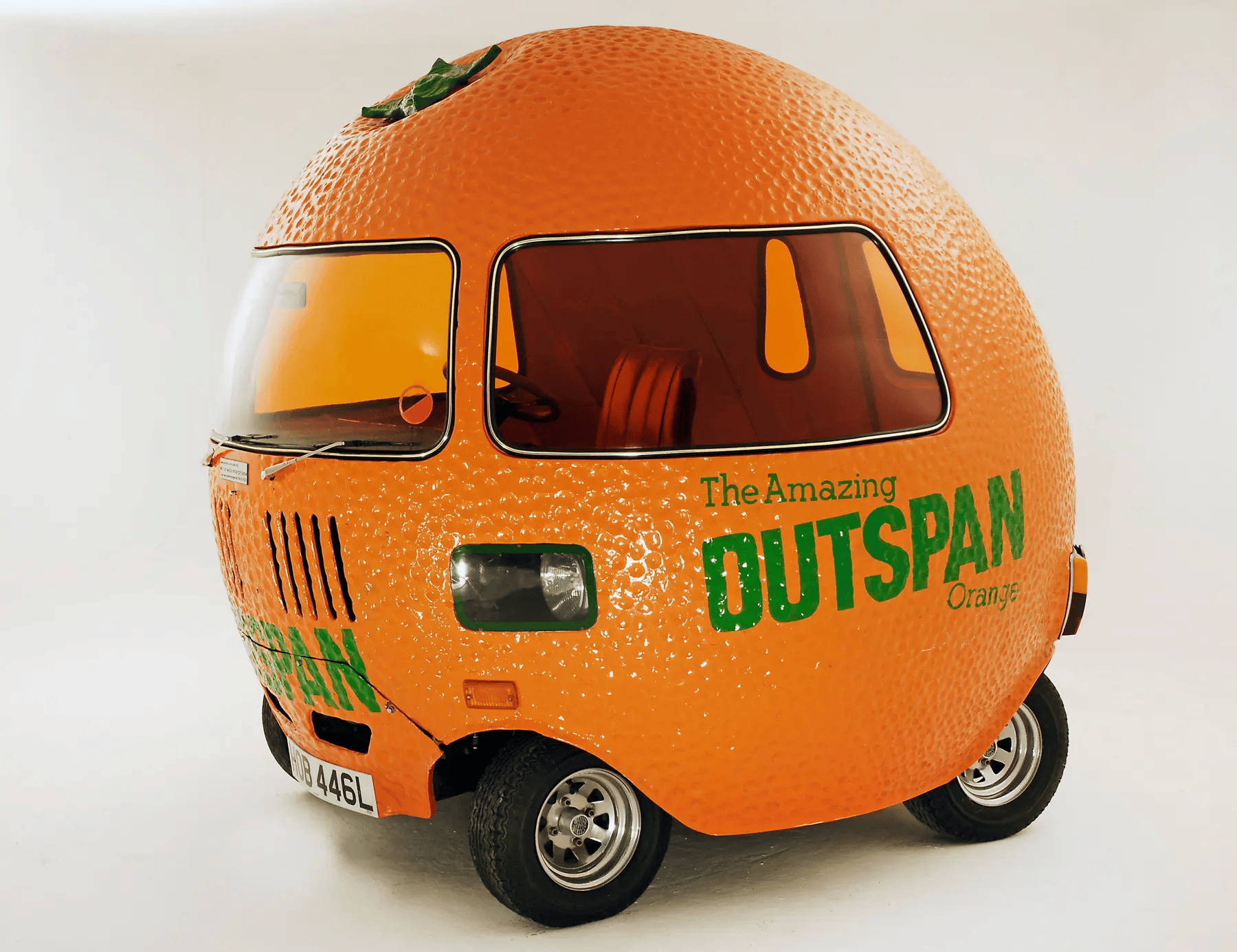
If cars and dog walking are not your thing, you can contract chronic “Yacht Envy” passing boatyards and marinas, taste “Old Thumper” and “Boonwoggle” ales at the Ringwood Brewery, e-cycle or pedal push on the flat, well-tarmacked roads or off-road on designated trails through the heath, golf, walk the Monk’s Trail, scale Picket Hill. Telegraph Hill or Piper’s Wait (423’), enjoy the Georgian seaside market town of Lymington, Exbury Gardens and Light Railway, Fordingbridge’s seven-arched medieval bridge crossing the Avon (you no longer get arrested for transporting venison over it) and the pre-Raphaelite church of St Michael and All Angels” at Lyndhurst, where Alice Liddle- the inspiration for Lewis Carroll- is buried.
Just like a sybaritic outdoor bath (for dogs) outside the High Corner Inn, no visit to the New Forest is complete without toasting the former royal playground with a pint of “Orchard Reveller” or “Snake Catcher Scrumpy” cider, the latter named after the nineteenth-century adder-catcher, Harry “Brusher” Mills, who supplied London Zoo and believed boiled adder was good for rheumatism.
But don’t drink too much or you’ll end up looking like a commoner with the rather mottled complexion of a local Gloucester Old Spot. And end up standing in the road being beeped at.
Nearly legless and certainly tailless.